• Hint: click the "What's New" tab and make that your homepage! On mobile: tap the Lighting Bolt in the upper right corner.
  • After completing the registration form, you will receive an email containing a link that you must select in order to confirm your email is valid. Check your spam/junk folders if you do not receive this message!

Current "Modern" available clothing for preparedness?

JasonM

New member
Verified Member
United-States
What would your list be for yourself? For a family of four...more? What would you recommend to prepare for what's coming. Long lasting clothing and material to enable survival through whatever comes now and into the next era? This is about 1st - what to stock and/or use NOW and 2nd - what to learn to harvest, sew, create later for use well into the future when what you have now fails you.

A few things to start:

- wool socks
- wool under garments
- linen over shirts
- dense wool/coated or oiled or leather jackets?
- animal hide gloves/jackets?

Trying to think what would be accepted as "normal" now but still be useful into the new age...and go beyond that for step 2...
 
If we’re looking at much more intensive solar activity, I would imagine long sleeve fishing shirts with hoods would be an advantageous item. Most of them come with some form of SPF solar blocking material. If you cannot outright find camouflage then I would look at earth tone colors. I pretty much wear 90% merino wool socks. If you’re gonna buy them, though, you really need to check the packaging. A lot of them will advertise Merino wool, but may only have a small percentage woven into the clothes item. It pays to read the packaging.
 
I live in Central Canada. And in a cold climate, nothing comes close to fur. There really isn't.
I don't wear fur usually. Down outerwear is fine when you have a warm house and a warm vehicle. But after TSHTF when "warm" means just above freezing, I'll be going for fur.
I have been slowly accumulating furs. Learned to brain / egg / soap tan them, and made a pair of gauntlet mitts to learn how to make clothing from them.

Being a cold dry climate, I find that that plastic fleece works better than wool. It wrings out and dries super fast when wet. Terrible for your endocrine system, and so before TSHTF I prefer the natural fibers.

In the Summer, I go to the thrift store and find high quality linen or cotton business shirts. I also picked up a traditional Indian groom's wedding outfit, which has a one piece linen shirt that goes all the way down to around your knees. It's great for working in the garden while out in the sun.
 
Wool is going to be super important again, but it is super labor intensive to make clothing from. Learning how to process wool and other animal fibers has been an ongoing project of mine.

Traditional woolen clothing wasn't like modern clothing either. In many places, the wool wasn't scoured to the same extent that it is now. This means that a certain amount of lanolin (grease) remained on the fibers. This makes picking and carding more difficult (which is why they scour the wool thoroughly these days), however the finished garment is a lot more water resistant, and has better insulative properties when wet. Spinning "with the grease in" is also something of a lost skill which is slowly making a comeback.

Shepherds had especially greasy woolen outerwear as well as blankets.

The other important product from wool is felt. In my climate, felt liners for winter boots, hats, and mitts are essential if you want to avoid frostbite. Felt blankets are also a lot les labor intensive to make. You can also make felt from other animals, like cats and dogs.

As labor intensive as it is, I can see why wool was such a key societal material. There are many, many hours in the winter months when there is not a lot to do while sheltering from the elements. Keeping the mind and hands busy prevents a lot of stabbings ;)
 
I seem to recall reading somewhere from 100% linen material would also be beneficial for blocking the suns rays
 
Last edited:
Something to consider is leather. Even if you aren't a leather person now.

My local thrift store has lots of leather jackets, and they cost about $20-$30 Canadian. I actually use them as a cheap source of leather for making other items like the palms of fur mitts and linings / repairs for leather shoes. Just remove the stitching, the lining, and save the pieces.

Leather is windproof, highly water resistant, warm, and extremely hard wearing. Being typically brown or black, they also don't stand out in urban or natural environments. They are somewhat puncture and slash resistant, which provides protection from encounters with wildlife or armed people.

I would go for one on the larger / longer side, and then sew additional pockets into the lining.
 
I have a set of clothing I bought from the thrift store that is a few sizes too big for me. It also has a belt that is too big also.
I made new holes in the belt and wear it when I'm gardening and kicking around doing chores.

The idea here is that when the killshot happens, everyone in my community is going to be losing a hell of a lot of weight. I need to also appear to be doing the same, otherwise I will likely get a visit from a hungry crowd intent on getting their fair share of my food stocks.

This is called a gray man strategy. I will also be knocking on doors in my neighborhood, like everyone else will be, asking for food. Whenever I am outside and visible by someone anywhere, I will be wearing my oversized clothing.
 
One major challenge (and i don't have a solution for) is footwear.
Almost all footwear is manufactured in ways that result in an unrepairable shoe which lasts only a season or two.

Consider that the average North American is on the verge of obesity (heavily overweight). They walk maybe 1,000 steps per day, and that's almost exclusively on flat, level surfaces. And most likely indoors for 90% of that.

Fashion footwear is completely impractical, and everyday footwear is engineered for that market I just described.

Which leaves us with outdoor and athletic footwear. Trekking boots are an option. But they are designed for occasional use on groomed trails. Army boots are engineered for long marches and are probably your best boot option. But you can run in boots without extensive physical conditioning, and even wearing boots day in day out often causes knee issues for the average Joe because of that extra weight.

Running shoes are designed to be thrown away after 6 months, and are not designed for lateral movements. That leaves trail running shoes and things like tennis shoes. All of which are not designed to last more than a year.

The other issue is you. I grew up in bare feet, and kicking around rocky shore lines. Moving to North America, I was shocked at how weak the average person's feet and ankles are. I'd bet that most people couldn't run the length of a football field in bare feet without injury. It's not just a lack of lower body development and excess weight either, it's also a lack of coordination and the brain's unfamiliarity with navigating uneven surfaces.

I am telling you right now that post solar kill shot, every surface is going to be uneven! Debris is going to be everywhere.
You Need to prepare your body and mind just as much as everything else.

As far as footwear goes, I would go for a pair of quality army boots, and a pair of trail runners. Preferably, the boot uppers are glued and stitched to the soles, but they are very hard to come by (army boots aren't made that way anymore).

Footwear will be available immediately after the collapse, but they will be mostly impractical, and the ones that are actually useful, will fall apart in a matter of months of daily use in ways they were never designed and made for.

You may have to be making your own footwear sooner than you think.
 
Thread and needle , the best you can aquire, so you can stich it all back together for the rest of the great grand kids lives.
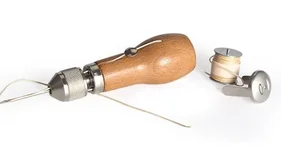
I also recommend a leather sewing awl like this:
1786540967586.webp

They are not super expensive, and are a much faster way to sew furs, leather, and other thick material than a needle.
 
I've been super-duper interested in whether anyone in the community can affordably reproduce Weatherwool products. If you're unfamiliar, make sure you're sitting down before you click the link or the prices could knock you over! The reasons for these prices are a combination of demand, supply chain, and attention to detail, but they are expensive nevertheless.

I've owned one of their Anoraks for several years and can personally vlattest to the quality of their products and their utility in the field. Garment production is not in my wheelhouse, but I suspect there is a market opportunity to compete with here and do significantly better on price.

This is an enthusiastic recommendation for anyone who can swallow the price tag.


For anyone interested in investigating that possibility, there is a ton of info on their website

Wool used: WeatherWool Fabrics
More on the wool: WeatherWool Wool
Supply chain explanation: WeatherWool Certified Fine Wool
Process: Start to Finish
Related information: Related Information
FAQ: WeatherWool Answers Frequently Asked Questions
 
Insane the price might be, but the amount of energy and human labor that has to go into making a garment like these is even more insane.
Raising the sheep, shearing, grading, processing, and actual fabrication is enormous, even with mechanization.

We are just completely accustomed to cheap clothing that is spun out of petrochemicals in a giant factory.
 
Just my 2 cents, and some has already been said by others, I try and wear only cotton, or as high of a percentage as I can get, Linen is supposed to be better for you than cotton, cotton being a close second. These 2 materials along with silk I believe are the most inline with our personal magnetic field, and helps build it up. All the petrochemical products bring down your energy. I do try and buy as much merino wool products I can due to the weather we can get, and I look for sales on any items I can find. And at the right time of year you can get some decent sales. Like cotton, I look for the highest percentage of merino in the product. And yes buying for more than yourself is very hard, and can be expensive.
 
Back
Top