• Hint: click the "What's New" tab and make that your homepage! On mobile: tap the Lighting Bolt in the upper right corner.
  • After completing the registration form, you will receive an email containing a link that you must select in order to confirm your email is valid. Check your spam/junk folders if you do not receive this message!

Distilling

S0NWO

Active member
Verified Member
OK I'm going there. Distilling is actually a very useful skill to have post SHTF.
You can make spirits for bartering of course.

It's also a source of alcohol, acetone, and methanol for medicinal tincturing and extraction.
And if you're doing it at scale, it's an important source of liquid fuels.

Here is my 2026 batch of apple brandy that I just made using 10 gallons of apple jack (freeze concentrated apple cider).Cal26.webp
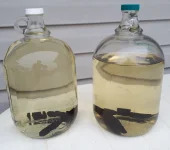
 
This summer I have been making single malt from scratch. I bought a sack of feed barley from the seed and feed, washed it, sprouted it, dried it, and then kilned it to various colors to bring out the malt profile I wanted.

Then I mashed it in, fermented it, and stripped it (the first fast distillation). Today is the final batch stripping run (I fermented 3 batches).

Tomorrow will be a long, slow, final spirit run where all the distillate I've collected will be re-run, and collected in stages. I will then select which stages make the final cut based on flavor and aroma.

Finally, if I decide to make a scotch type whiskey, I will bubble some peat smoke through the spirit to imitate the peat smoked malt that it traditionally used.
 
Awesome! Did you make your still yourself or did you buy it? My partner and I are herbalists and have long discussed distilling our own alcohol. We haven't had a clue where to start though.
 
I made it myself. I used one of those big coffee urns as the boiler, and I use a motor speed controller to dial the temperature up or down.

I used 1.5 inch copper pipe for the neck, and then I made a shotgun condenser from lengths of 1/2 inch copper pipe inside a 4 inch pvc pipe. That was a challenge because I had to fabricate manifolds. Cold water in a pail gets circulated through the shotgun condenser using a small electric pump, and when it gets too warm, I refresh the water.

It's not great for making high purity neutral spirit, but it gets the job done. The neutral spirit I make with a tomato paste wash is perfectly fine for tinctures and fortifying wine etc.
 
OK I'm going there. Distilling is actually a very useful skill to have post SHTF.
You can make spirits for bartering of course.

It's also a source of alcohol, acetone, and methanol for medicinal tincturing and extraction.
And if you're doing it at scale, it's an important source of liquid fuels.

Here is my 2026 batch of apple brandy that I just made using 10 gallons of apple jack (freeze concentrated apple cider).View attachment 121
How can you make acetone ?
I had no idea (as you can tell :)
 
I made it myself. I used one of those big coffee urns as the boiler, and I use a motor speed controller to dial the temperature up or down.

I used 1.5 inch copper pipe for the neck, and then I made a shotgun condenser from lengths of 1/2 inch copper pipe inside a 4 inch pvc pipe. That was a challenge because I had to fabricate manifolds. Cold water in a pail gets circulated through the shotgun condenser using a small electric pump, and when it gets too warm, I refresh the water.

It's not great for making high purity neutral spirit, but it gets the job done. The neutral spirit I make with a tomato paste wash is perfectly fine for tinctures and fortifying wine etc.
Wow. I wish I could've watched you build it. That's fascinating. How did you get the idea?
 
Yeast fermentation produces ethanol in the vast majority, but it also produces methanol, acetone, and other fusel alcohols in small quantities.

The methanol comes off the still first, and I save it for cleaning, burning, and tincturing for external use.
Next is acetone, and I save it for the same reasons. The amount depends a lot on what is being fermented. Apples for example produce quite a lot of methanol and acetone, which is why applejack is notorious for epic hangovers.

In distilling spirits for consumption, these are called the heads. Craft distillers remove almost all of it from their finished product. The big commercial manufacturers add a portion back in to bulk out their product, and it's largely responsible for the hangover.
 
Wow. I wish I could've watched you build it. That's fascinating. How did you get the idea?
The idea goes back a long way. My grandmother came from Normandy in France. The region where Calvados (apple brandy) comes from, and her family had a tradition of making it. They actually ran their farm equipment on the stuff during the WWII German occupation.

When I was 12, she bought a bunch of materials and had me build a still for her. I was already tinkering with fermentation so this was a natural next step.

You're probably wondering if I'm a raging alcoholic LOL. But growing up around alcohol from a very young age had me view it as just another thing you had at meal time. The whole binge drinking teenage thing never had much of an appeal for me.

Most of the spirits I make I don't actually drink. It takes years and years to mature, and the majority is stockpiled as a barter item.
 
The idea goes back a long way. My grandmother came from Normandy in France. The region where Calvados (apple brandy) comes from, and her family had a tradition of making it. They actually ran their farm equipment on the stuff during the WWII German occupation.

When I was 12, she bought a bunch of materials and had me build a still for her. I was already tinkering with fermentation so this was a natural next step.

You're probably wondering if I'm a raging alcoholic LOL. But growing up around alcohol from a very young age had me view it as just another thing you had at meal time. The whole binge drinking teenage thing never had much of an appeal for me.

Most of the spirits I make I don't actually drink. It takes years and years to mature, and the majority is stockpiled as a barter item.
They will be great barter items. Alcohol is needed for cleaning wounds and taking the edge off of pain.
Jack Daniels whisky is made in a dry county - no alcohol drinking. Thanks for the fusel oils knowledge. Getting temprature, ph, sugar and enzimes right is an art.
I need to get a Multi point column distillation tube like on Youtube "Tech Ingredients " Each section distills the vapor multiple times for true separation.
 
(former EMT and now herbalist and trained austere trauma medic here) ....please never clean wounds with alcohol. That's an old myth. It is not only painful, but damages healthy tissues and delays healing. I'd only use it as a very last resort if I had absolutely nothing else and no clean water. Plain water with nothing added is the best thing to clean wounds with. I would not even add soap as then you have to clean the soap out of the wound. Plain, clean, water for wound cleaning is all that's needed.
 
(former EMT and now herbalist and trained austere trauma medic here) ....please never clean wounds with alcohol. That's an old myth. It is not only painful, but damages healthy tissues and delays healing. I'd only use it as a very last resort if I had absolutely nothing else and no clean water. Plain water with nothing added is the best thing to clean wounds with. I would not even add soap as then you have to clean the soap out of the wound. Plain, clean, water for wound cleaning is all that's needed.
Noted. Thank you. That is important information.
 
My g
(former EMT and now herbalist and trained austere trauma medic here) ....please never clean wounds with alcohol. That's an old myth. It is not only painful, but damages healthy tissues and delays healing. I'd only use it as a very last resort if I had absolutely nothing else and no clean water. Plain water with nothing added is the best thing to clean wounds with. I would not even add soap as then you have to clean the soap out of the wound. Plain, clean, water for wound cleaning is all that's needed.
My grandfather actually died in his 80's due to this.
He went into the hospital for a hip replacement, and while they were busy operating, nobody noticed his heel was rubbing badly up against the railing at the foot of the table.

He came out with a massive blister that covered his heal. Instead of just covering it and leaving it well enough alone, they cut off the skin and poured alcohol in the already sterile wound.

That wound became infected, ulcerated, and he died from sepsis. It was a completely avoidable situation.
 
That's really sad that your grandfather died from something so avoidable. I'm sorry for your loss.
A note on alcohol tinctures for herbal medicines. MOST tinctures are made at 80 proof for normal herbs. Things that need higher proofs are good at 100-190 proof and those would be the thicker things like barks, thicker woody stems, or roots. But just for leaves, flowers, small stems, a good 80-100 proof is plenty strong.
 
same same... when I buy it, I just buy the grain/everclear stuff. Then adjust too. :D I love that you make your own. Apple sounds amazing! By chance do you have that book called the Bootleggers Bible?
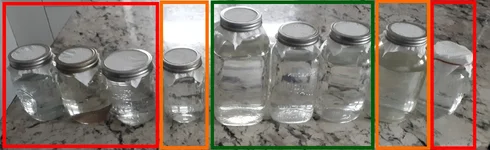
 
This is the total distillate that I collected. The jars on the left are first ones to be collected and they are in order of collection.
cuts.webp

I will smell and taste each one to see if it is suitable for the final product. the ones in the red boxes I expect will not make the cut. The green box is called the hearts, and always makes the cut.

The orange ones may or may not make it.

As you can see, a good portion of the run won't actually make it as whiskey.
 
Back
Top