I think the viability of the floating away plan could depend a lot on location, even beyond elevation and distance from ocean, like proximity to Euler axes which affects relative oceanic velocity at the site.
The safety of a given location may vary drastically on whether the EDC or ECDO theory (or another theory) is true, as they have different poles and predicted velocities, with I believe Ben's being much lower and more survivable. Please correct me if I'm wrong; I'm definitely not certain of this. His info is harder to find due to it mostly being in video format.
In ECDO theory at least, the velocities don't seem that survivable to me for floating away for most people.
These are The Ethical Skeptic's "theoretical initial oceanic inertial velocities at original angular momentum" for the event as
stated in the caption to this image:
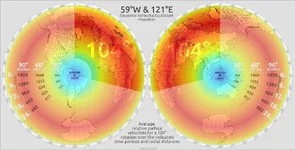
It appears he is showing the degrees from the Euler axes, so the faint radial lines are the reference points you'll want to look at for your location.
Since I'm much more familiar with mph than km/h, I'll convert the velocities for the potential shift timelines (in hours):
| Distance from Euler Pole | 6 hr | 9 hr | 12 hr | 18 hr | 24 hr |
| 30 degrees | 599 mph | - | 300 mph | - | 150 mph |
| 60 degrees | 1036 mph | 778 mph | 518 mph | 389 mph | 259 mph |
| 90 degrees | 1198 mph | 798 mph | 599 mph | 399 mph | 300 mph |
The velocities decrease over hours to eventually settle to normal; it's the initial surge that's most concerning.
So if I'm understanding this right, under ECDO theory, any vessel at 30 degrees from the Euler pole would have to withstand approximately 150 to 600 mph (depending on the speed of the geographic pole shift) of water at the coastlines and flat lands nearby. And those near the West Coast US along the 60 degree line (hard to see the faint lines in the image), where I think a lot of people in the pole shift community are closer to, would contend with an initial surge of 259 to 1,036 mph.
The initial impact of water would likely be fatal at those speeds, until sufficient slope or distance softened it. The only potential exceptions I can think of that could work are floating away from a location with high elevation relative to the surrounding area, a mountain range conveniently acting as a shelter or buffer for a lower elevation area, or being at the Euler axes where there's less movement to begin with. Just make sure to clearly define the expected conditions first and then select a vessel designed to withstand those conditions.
In summary, since most people live at the coast and lower elevations, I don't think most would survive a floating away plan due to the unimaginable force of the initial surge. I am just a layperson though so hopefully I am reading this entirely wrong.
A useful source on potential safe spots specifically for the inundation aspect of the event is Junho. From what I've seen, Junho has global, high-definition water displacement simulations based on ECDO theory, which you can
see on X and the final results from them in
their fourth paper.
[Edited to reduce image size, convert all speeds, and link to Junho.]